
On Hell: Part 2
The Human Fingerprints on an Ancient Doctrine

1990-something. I was around nine or ten years old and had just finished watching Carman’s dramatic “Revival in The Land” music video on VHS. The video opens in Hell where a heavy-metal looking version of Satan is being briefed by one of his orc-looking demons about the success of their strategy to deceive humans. Abortion clinics, television violence, and astrology were a part of Satanically-driven tactics to destroy young people’s lives, and according to the statistics presented, Satan was victorious on many fronts.
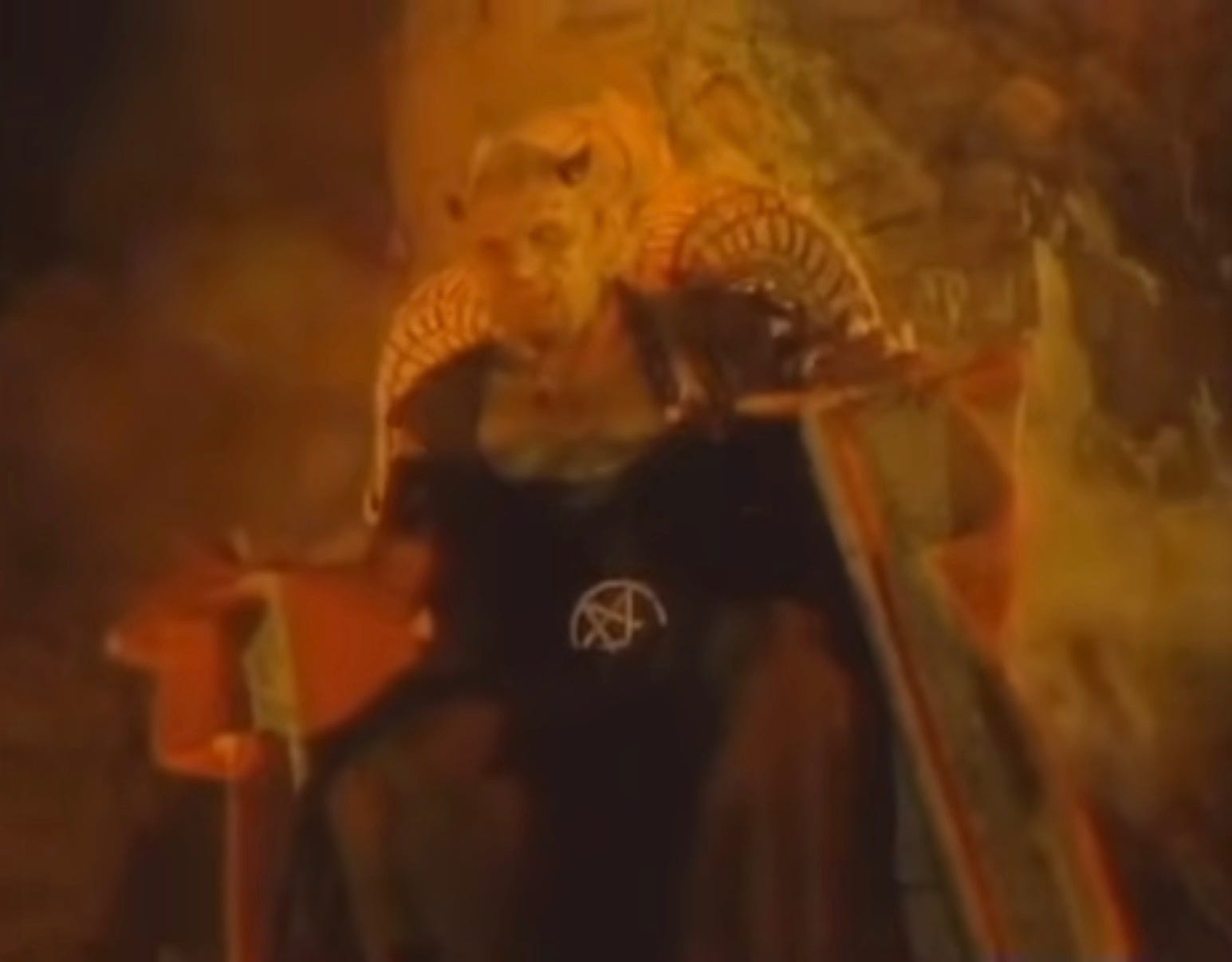
Aesthetically, the video was terrifying enough to my young mind as Satan and the demon’s hellish prosthetics - while they couldn’t hold a candle to Tim Curry’s Darkness in the film Legend - were scary enough. But what was even more powerful in that moment wasn’t the aesthetics of Hell - the fire surrounding them, Satan’s throne with a pentagram at the crown of the chair, or the darkness of the forsaken cavern they were standing in. It was the message: the “rebellious teenagers” Satan watched on a screen, the morally wicked people they approved who aligned themselves with the devil by participating in immoral things, and on the contrary, the Christians - “holy terrors”(Carman’s words, not mine) with lifted hands, feared for being on their knees in prayer. And this shaped me more than anything.
I was one of them. And my eight year old next door neighbor, because he didn’t attend church and listened to “secular” music, was not.
What I watched was just one of the things that contributed to an “us versus them” mentality where people like me would end up in Heaven and people like my neighbor would end up in Hell. I needed to warn him. Condemn - I mean - convict him... He needed to change his behavior if he didn’t want to end up beside motorcycle Satan and his goblin-looking minions.
I went outside, looked him in his blue-eyed, freckled face, and told him he was going to hell.
I was nine years old, armed with certainty about the eternal state of the wicked - or who I thought was wicked - and I was convinced I was doing the loving thing. The right thing.
I no longer believe in Hell.
If that wasn’t clear in Part 1, that was intentional. My focus was on presenting the data, particularly to an audience that either still believes in Hell as a literal place where the wicked are eternally and consciously tormented, or to people who might still be psychologically haunted by that version of Hell’s shadow and find it difficult to shake. As much as I’d like for people to form the same conclusion I have about it now, that’s a choice they’ll have to make after analyzing the data and reconciling it with traditional views on Hell.
I no longer believe in Hell.
Not the depiction from 90’s films.
Not motorcycle Satan.
Not the place I weaponized at nine.
…and that is due largely to the reasons I stated in Part 1 - seeing how The Gospel of Matthew filters Jesus through an apocalyptic lens and subsequently saturates his language in “hell sauce” - with apocalyptic judgment imagery everywhere. More broadly, this led me to see how the other writers of the gospels did the same thing with Jesus in their writings, in other ways. The Gospel of Mark presents Jesus, among other things, as “a son of a god”. He opens his book with this exact language. The Gospel of Luke weaves in Jewish and Greco-Roman literary themes and motifs generally ascribed to divinely favored heroes during those times. Even John’s Gospel, from the outset of his book, is committed to displaying Jesus as the pre-existing logos, which was a term from Jewish wisdom and Stoic traditions. This practice of recontextualizing a figure is something writers during this time and throughout Classical Antiquity frequently did to suit their own literary purposes. Scholars have argued that even Paul recontextualizes the historical figure Adam and Jesus to support his own premises1. Divine transmission aside, this is a human pattern, not unlike how Jesus is still reinterpreted and recontextualized to speak into our own contexts.
My argument is not that Jesus never speaks about judgment, it is that the writer of Matthew utilizes Jesus’ words on Hell for a larger narrative purpose that has less to do with a person’s status in the afterlife and more to do with their behavior in the current one.
In last week’s essay, I touched mostly on how Matthew incorporates Enoch’s apocalyptic language and images, but I didn’t focus on why. Scholars have differing reasons, but many of those reasons orbit around the premise that Matthew was taking the centralized figure of the historical and prominent Enoch - the one to whom divine revelation came about the end of the age - and replacing him with Jesus.
Amy Richter states that Matthew refers to certain elements of Enoch “in his Gospel in such a way as to show that Jesus completes what Enoch does not.”2
Another scholar, David Sim states that “Just as the apocalyptic authors used great figures of the past to present and lend authority to their own views of reality, so too does Matthew. He uses no less a figure than Jesus the messiah, Son of God and Son of Man to convey and authorise this new [apocalyptic] symbolic universe. In doing so, Matthew gives his vision of reality an authority and legitimacy which it might not have carried had he not expressed it on the lips of Jesus.”3
There’s something that Matthew seeks to accomplish by adopting Jesus as his spokesperson so that when people hear these words coming from the mouth of Jesus, they listen…and obey.
Adapting the Man…The Son of Man, That Is
Remember last week, how I said that there were even clearer examples of Matthew’s relationship to 1 Enoch? Again, not dependence or plagiarism, but adaptation from a shared perspective? Here’s another one. We’re used to hearing the term “Son of Man” in the gospels because it’s a title that Jesus referred to himself as. Many of the resources I learned from in Christian spaces said that Jesus was borrowing the term from the apocalyptic book of Daniel. And in certain texts, Matthew does. David Sim believes that Matthew blends traditions in what he sees in Mark and Quelle (a common source predating the gospels containing statements of Jesus) when it comes to the Son of Man. But the book of Daniel is not the only place predating the gospels where Son of Man is referenced - and this is where Matthew leans in. Enoch references the Son of Man as well, and Matthew adds a description of the Son of Man that’s only found in Enoch: a Son of Man who sits on a throne of glory at the end of the age and judges the world (Matt 19:28 1 En 62:5). Certain scholars believed that the Son of Man in Enoch was none other than Enoch (1 En 71:14); others think he’s an anonymous figure. But in Matthew, this Son of Man is Jesus.
What the writer of Matthew is doing is blending Jewish and Christian traditions, but also recontextualizing Enoch. While Daniel depicts the Son of Man receiving dominion before the Ancient of Days and Mark emphasizes his coming in the clouds, neither explicitly portrays him seated upon a throne of glory as judge of the nations — a detail prominent in 1 Enoch and echoed in Matthew.
But why? Why does Matthew position Jesus in this way?
Maybe a modern example will help. Do you remember in the first Avatar movie when Jake Sully, in his Avatar body, attempts to warn the Na’vi people of the coming destruction of their Hometree by Colonel Quaritch, but he’s rejected by the people because he’s not a real one. It’s only when he connects with the Toruk and becomes the sixth Toruk Makto - the ancient and respected Na’vi rider that brings unity and peace - that he gains the trust of the people and they listen to him.

Like Toruk Makto, Matthew portrays Jesus as the fulfillment of this ancient apocalyptic figure who is trusted by and recognized among his people because of his unique credentials and position. His unique credentials are having a throne of glory on which to sit and his unique position is the ability to judge the world on that throne. Thus, Matthew’s adaptation of Jesus in this way gives him ultimate authority over everyone and everything, and this has implications on the way people live in the community to which Matthew writes.
Adapting The Message
In the previous essay, I highlighted Matthew 25 as a parallel to Enoch’s Animal Apocalypse to show Enoch’s apocalyptic influence on Matthew. The similarities between the accounts are important - the animals, the allegory, and the judgment - but the differences matter too, because what Matthew does differently from Enoch actually points to what his purpose is for writing. So what are the differences?
In the larger context of 1 Enoch, the corruption of the world originates with the rebellion of The Watchers. Their judgment precedes and grounds the judgment of earthly powers: the Nephilim, corrupt rulers, oppressive elites, and wicked nations. As one scholar says, “This [The Watchers] cause of sin must be wholly destroyed before righteousness can come truly to its own.”4
Zoom in. In Enoch’s Animal Apocalypse (1 En. 85–90), the Watchers are symbolized as shepherds appointed over Israel - the sheep. The shepherds are condemned not merely for negligence but for slaughter and exploitation. Blind sheep are also judged for participating in that violence. Both shepherds and sheep are ultimately cast into a fiery abyss.
In the parable of the sheep and the goats, things shift. The cause of sin isn’t cosmic. There are no rebellious angels. No mythic offspring. No cosmic story explaining the world’s corruption. The cause of sin and brokenness in this world is painfully ordinary. In Jesus’ parable, the sheep and the goats aren’t fallen angels and blinded rulers, they’re those who either see the vulnerable or turn a blind eye to them. Those who fed or refused to feed the hungry. Those who clothed or refused to clothe the naked. Those who cared or refused to care for the sick. Those who visited or refused to visit the prisoner. Different from Enoch, in Matthew corruption doesn’t move from the top down; it moves from the inside out.
Matthew adapts the message of Enoch, existing within the same apocalyptic universe of thrones and judgment and fires, but in the mouth of this Son of Man, the target has changed. In Enoch, the drama is cosmic. In Matthew, the drama is communal. The Son of Man’s all powerful judgment does not fall on angels who neglect their station, it falls on those who neglect their neighbors. Matthew still includes the supernatural realm and speaks within the apocalyptic imagination throughout his gospel, but he domesticates it. The Gospel of Matthew relocates the battlefield of evil from the heavens to the neighborhood.
So what does this have to do with Hell? I’m glad you asked. If you haven’t seen it by now, Hell or Gehenna functions as a rhetorical tool within a larger apocalyptic - symbolic - universe. But that doesn’t make it any less scary. Because what Hell represents is a far scarier reality for Matthew’s audience than a geographical place with all the modern terrors we have projected onto it. And what those terrors of eternal conscious torment do to us, is likely similar to what the terrors of shame, exclusion, and being cut off from the community of belonging did in Matthew’s audience. The fact that Jesus could look around and point his hearers in the direction of a historically cursed valley outside of the city might have added additional weight. The Valley of Hinnom was an actual place that carried communal memory of shame and failure, not unlike Chernobyl or Auschwitz, or even Ancarrow’s Landing (aka the Manchester Slave Docks) - which is a short walk from where I’m writing this.
Last week, Malcolm Reeve from SQ Magazine reviewed Part 1, and I think this paragraph from his review nails the reason behind why Jesus’ Hell is still so profound, even if it is not literal. He states,
A Gehenna that functions as a warning about what a person or a community becomes by choosing exclusion, cruelty, and the sustained worship of power is, in some ways, more demanding than a literal fire awaiting the doctrinally unsaved. The literal version can be managed. Learn the correct beliefs, say the right words, and remain inside the right institution holding the gate. The symbolic version offers no such management. It asks what you are doing right now with the neighbor in front of you.5
For Matthew, Hell is a concept that is less concerned with what you believe about it, and more concerned with what you do about it. Because the Gospel of Matthew was believed to be written a few decades after Paul’s major letters, yet Matthew does not articulate salvation in Pauline, forensic terms; instead, his depiction of final judgment aligns more closely with Jewish apocalyptic traditions, where judgment is rendered according to deeds, especially justice and mercy. This doesn’t mean Matthew is competing with or correcting Paul. What it reflects is the emphasis on salvation and judgment of a different kind of Jesus-following community (think Christianities instead of a singular Christianity). This is why harmonizing the gospels or even the collective books and letters of the New Testament into a single theological thread is not always the best practice for understanding the meaning of each writing.
From What The Hell to Why The Hell
He who has ears to hear, let him hear - Matthew 11:15
How Matthew’s recontextualization of Jesus landed on the ears of his audience is anyone’s guess, but what we can know about that audience and what we already know about Matthew’s apocalyptic warnings can give us a clue.
And here’s another clue: this is where the human fingerprints are.
Time, space, and our modern attention spans won’t permit me to get into the trenches of the context of Matthew’s community, so I’ll give you a summarizing quote from David Sim. About the community that Matthew writes to, he says,
The social setting of this Antiochene Christian Jewish group is thus one of extreme crisis occasioned by the effects of the Jewish War. As a law observant Christian community, it now had little in common with the world of formative Judaism, even less in common with the remainder of the Christian world and nothing at all in common with the wider gentile society. The Jewish war had to all intents and purposes decimated all its external support systems. It could not now turn to the greater Christian church for help in its conflict with the synagogue, nor could it expect any assistance from any Jewish sources in its conflict with the law-free party within Christianity. The Matthean community was essentially cut off and deeply alienated from all external institutions, be they Jewish, Christian or those of the gentile authorities, and approached them all with a mixture of fear, bitterness and hostility.6
Matthew’s community was one on the outs during a time of crisis and they had some beefs with just about everybody - especially the Jews in the synagogue by whom they were most likely persecuted and abused. They were far from the only group that could be called a “sect” during these days, but it’s within the setting of their alienation that Matthew’s words of his adapted Jesus strike the hardest. Apocalyptic literature has always functioned in this way - speaking out of its particular social settings and driven towards a response.
In his writing, Matthew gives his community identity and purpose, adopting a dualistic perspective: good versus evil, God versus Satan, the ekklesia versus the world. He offers theological explanations for the distressing circumstances they find themselves in. He gives them the hope that righteousness will prevail because the end is coming when the Son of Man returns who will reward the righteous and judge the wicked.
…and you don’t wanna be found with the wicked, do you? Do you?
Now, it should be noted that, much like modern humans, Matthew has his sights set on particular people when he describes the fate of the wicked: the Pharisees, law-free Christian communities, some gentiles, and those who reject “the least of my brothers”(Matt 25:45), which some scholars believe refers not to Christians in general, but Matthean Christians particularly7. Matthew rhetorically directs Gehenna toward identifiable adversaries within his social world. And identifying and condemning “the opps” in this way is supposed to provide consolation and satisfaction for vengefulness for those who’ve been mistreated by “the opps.”
But lastly, another reason why Matthew includes the strong language that he does about Hell is for social control and maintenance of community boundaries, and this really is no different from the way that Hell has always been used as a theological tool. As an isolated sect with its back turned to the world and even other Christians, it was vital for Matthew’s community to be tight knit. And that closeness came through and was preserved by their commitment to a shared moral framework: not being judgmental - ironically (Matt 7:1-5), being humble (Matt 18:1-4), forgiveness (Matt 18:35) and concern for the weak. But in the same way that Matthew spelled out the hellish horrible fate of those outside the community, this worked like a double-edged sword for those inside the community who considered leaving it. The threat of Hell - separation, estrangement, and disconnectedness - loomed over the minds of those who didn’t act right or thought about parting ways. If you broke the moral code with a lustful look, Hell awaited (Matt 5:27-28). If you offended someone with a hand or a foot, Hell awaited (Matt 18:8-9). If you feared people more than God and subsequently shirked in your duties as a part of the community, Hell awaited (Matt 10:28).
Sim states that, “Those members who faithfully follow the code of conduct can expect eternal life as a reward, while those who break the code and put the community at risk will be horribly punished alongside the wicked outside the ekklesia.”8
For a community already isolated from the synagogue, family (Matt 8:22, 10:37), and the world at large, to be cut off from the ekklesia meant not just spiritual death, but more importantly, imminent social death.
I no longer believe in hell.
When I saw Matthew’s Hell situated in its original context, it was impossible to unsee. Hell has always been a concept used to divide and control and the insistence on its literalism has been another way to maintain that control. From the earliest centuries of the church to medieval theologians and artists, to today’s fire-and-brimstone preachers across Hell-affirming Christianities - even down to me as a nine-year-old - Hell has been used in strikingly similar ways. The “opps” change, the preconditions change, the residents of Hell change, but the tool - the utilization of the concept - remains the same.
What began as an adaptation used to comfort, compel, and even control became something ripped from its apocalyptic world and recontextualized to suit ours. Like Kirk Cameron’s recent experience, Hell has become a litmus test. Where Matthew’s Jesus spoke from a symbolic world that compelled people to act justly in this one, many of today’s proponents of hell speak of a literal place where the condemned go for not believing rightly. Both versions of hell are covered in human fingerprints - shaped by very real human emotions of fear, community, and the impulse to draw theological lines around who belongs and who doesn’t.
What is most unsettling about Hell is that as an overconfident nine year old, I was utilizing Hell exactly as it was designed to function. My freckled neighbor was supposed to feel the tension before I rescued him with a message of grace and love…only for him to exist in the tension of hell once more, this time from the inside.
Enns, Peter, The Evolution of Adam, 80. Enns states, “Paul’s understanding of the Adam story is influenced both by the interpretive conventions of Second Temple Judaism in general and by his wholly reorienting experience of the risen Christ.”
Richter, Amy, Enoch and The Gospel of Matthew, Ch.1, Loc 90
Sim, David, There Will Be Weeping and Gnashing of Teeth, 221
R.H. Charles, The Book of Enoch, xxi
On Hell: A Literary Review, https://substack.com/home/post/p-188530742
Sim, David, There Will Be Weeping and Gnashing of Teeth, 209
Sim states, “They can be satisfied and consoled that the many who have rejected and mistreated them in the past and who will do so in the future will receive their just punishment at the hands of the Son of Man. Sim, 231
Sim, 236
Appreciate the shout-out!